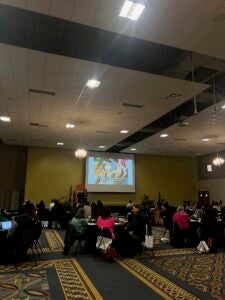
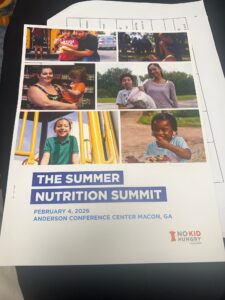
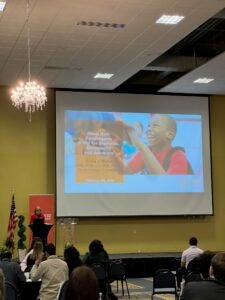
In February, No Kid Hungry Georgia was honored to host our first Summer Summit with DECAL’s Happy Helpings support. This year, our theme was “Innovating Rural Non-Congregate Together.” We had the privilege to hear from a wide array of speakers. Whether it be licensed experts from DECAL, No Kid Hungry Georgia’s staff, or community based-organizations such as YMCA Rome Floyd, attendees could learn about all kinds of topics from various perspectives.
Rather than try to summarize the summit ourselves, we interviewed Aleta McLean, Senior Director of Client Services and Outcomes Tracking of Open Hand, about her experience. Aleta and Open Hand is one of the many amazing community nutrition organizations that attended our summit and are dedicated to serving their communities this summer.
What’s something new you learned from the summit sessions?
Since this will be our first time applying as a rural non-congregate sponsor, nearly everything covered in the summit sessions was new and informative for me. I gained a much clearer understanding of the different delivery models available, including options for direct-to-home delivery and bulk distribution.
Learning about the flexibility within the rural non-congregate model—particularly the option to provide bulk meal delivery—was especially helpful as we consider what approach will work best for our community and operational capacity. The sessions provided practical insights that will directly inform how we design and implement our program moving forward.
Are there new partnerships / connections that you made during the summit that helps improve your program?
Yes, I made a valuable new connection during the summit. I met the CEO of the Black Lotus Project, who is also based in the Atlanta region. She has been leading this work for several years and generously shared best practices and lessons learned from her experience.
We also discussed potential opportunities to partner in the future. It was meaningful to connect with someone doing similar work who is willing to openly share insights and help strengthen programs across the community. This relationship has the potential to enhance our approach and expand our impact moving forward.
Interested in learning more about innovative partnerships to consider when operating your rural non-congregate program? Check out our slide deck and presentation on Innovative Partnerships Across the Nation.
What advice would you give for someone trying to operate rural non-congregate for the first time?
For anyone operating a rural non-congregate program for the first time, my biggest advice would be to take full advantage of the technical assistance available. There are many resources and supports designed to help ensure you are set up for success—use them early and often.
It is also important to make sure you have adequate staffing to manage the administrative requirements, as compliance and documentation can be significant. Starting small can help you refine your processes before scaling up.
Finally, collaborate with agencies you already have established relationships with. Strong partnerships can ease implementation challenges and expand your reach. Don’t try to do it alone—leveraging trusted partners will strengthen both your program and your impact.
What resource would you find most helpful when planning for summer?
It’s hard to identify just one resource, as several have been extremely helpful in preparing for summer. As a first-time sponsor, I’ve found the guidance and materials provided through NKH and the Georgia DECAL websites to be especially valuable. The information available has helped clarify requirements, timelines, and operational considerations, giving me greater confidence as we plan and prepare for implementation.