An update published every two months on No Kid Hungry Texas advocacy efforts and ways to take action to help end childhood hunger.

Stacie Sanchez, No Kid Hungry Texas Director
Welcome from Stacie: Standing Together for Texas Kids
Last month, I drove southwest to visit our phenomenal partners in Sabinal and Uvalde County.
Led by the relentless Kelly Earnhardt (Cafeteria Director at Sabinal ISD) and her team, they expanded their home delivery routes from 3 hours to a massive 8-hour trip every Tuesday and Thursday to make sure their students had food.
The real stars are the kids! They know every neighbor by name. As we approached a quiet home, the student volunteers explained that some kids aren’t allowed to open the door to anyone, but they are waiting inside. Sure enough, as our (un-air-conditioned!) bus pulled away, we watched a young hand reach out and pull the food box safely inside.
To keep our state strong and our families fed, here is what the latest data shows across Texas:
- Summer EBT (SEBT) Grocery Benefit: Texas is the second hungriest state in the nation and among ten remaining states opting out of SEBT, a federal program providing $40/month per child in grocery support during the summer months when school meals are unavailable. SEBT would bring $450 million in federal funds directly into local Texas grocery stores and nourish an estimated 3.5 million Texas kids—all for a state match of about $55 million.
- Impact on School Meal Programs: Drops in benefit programs like SNAP enrollment directly impact eligibility for the Community Eligibility Provision (CEP), which allows school districts that experience consistent poverty in their communities to serve free meals to all students. When enrollment dips, local districts lose automatic campus-wide eligibility (including 29 schools in my home district), requiring schools to return to standard paper applications.
When Texas neighbors show up for each other, big things happen! You can help support families and schools in your community today with one simple step:
Call to Action for Parents: As the new school year approaches, please make sure to complete your school’s Free and Reduced-Price Meal Application!
Thank you for standing with us, our local partners, and Texas children as we work together to nourish our future!
Wanna talk? Send me a message at Stacie Sanchez.
Fighting Summer Hunger in Texas
While school meals are a critical source of nutrition during the academic year, the end of the school year often marks the beginning of the hungriest time for many children across Texas. Data shows the urgency of this need: 62% of Texas parents report difficulty affording enough nutritious food for their children when school is out, and 1 in 5 kids in Texas experiences food insecurity.
That’s why a central pillar of No Kid Hungry Texas’ advocacy efforts is pushing for the implementation of Summer EBT (Electronic Benefit Transfer) in Texas, a proven solution for summer hunger. Summer EBT would provide eligible families with $120 per child over the summer on a pre-loaded card to purchase groceries, helping bridge the gap when school meals are unavailable.
If implemented in Texas, the program could reach an estimated 3.75 million children and bring approximately $693 million in federal funding into local communities, supporting both families and local food retailers. Already operating in 38 states, Summer EBT has demonstrated its effectiveness in reducing summer hunger and strengthening food access, making it a powerful, evidence-based solution we are advocating to bring to every Texas child.
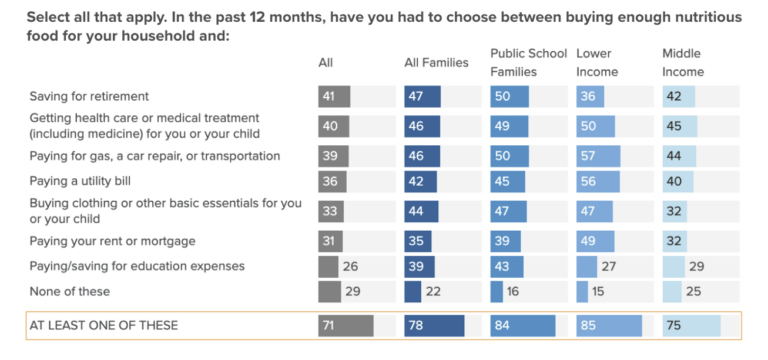
For many Texas families, “struggling to make ends meet” isn’t abstract. It means choosing between buying nutritious food and covering another essential — impossible choices no family should have to make. In a poll No Kid Hungry Texas conducted last year, 78% of families with children said they’d had to choose between buying enough nutritious food and paying for at least one other basic need, things like health care, utility bills, rent, or transportation. Summer EBT wouldn’t erase these hard choices, but it would ease them, freeing up money that would otherwise have to be pulled from rent, gas, or medicine.
Our next issue in September will feature fresh data, as our newest poll on Texas families is set to be released soon — stay tuned for updated insights on how families are navigating rising food costs.
What Texas Families Are Saying

Raven Behrens is the pre-K–2nd grade counselor for Brown Primary and Smithville Elementary, with 15 years in the district and two daughters in the schools she serves.
“Knowing that at those kids’ homes that their families are not able to provide for them in the same way that other families can provide for their children, I know that that has to be a heartbreaking thing for the parents in that home as well. So as a mom, I am fortunate that I am able to provide for my children in a way that I know that they’re not going to be hungry. But as a mom, knowing that that is an issue in our community, that is heartbreaking. And I believe that bringing awareness to it could facilitate change for this community and those families.”
Resources
- The Summer EBT Opportunity Map helps state law makers understand how many children could be impacted if Summer EBT is adopted in their state. Users can view data by county, state house, or state senate districts.
- The Summer EBT Implementation Tracker is a tool to help understand how states, territories, and Indian tribal organizations (ITOs) participating in Summer EBT have decided to operate Summer EBT to most effectively serve their eligible children and families.
- The Summer EBT 101 resource provides general information about the program.
- Most recent No Kid Hungry Texas Hunger Poll
Most recent No Kid Hungry Texas Hunger Poll
About No Kid Hungry Texas
No Kid Hungry Texas works across the state to ensure children have consistent access to the nutritious food they need to learn, grow, and thrive. We partner with schools and community organizations through grants, technical assistance, and resources that help strengthen school breakfast programs and expand access to summer meal programs.
Through advocacy, partnerships, and direct support for local communities, we work to advance long-term solutions that help connect children and families with reliable access to nutritious meals year-round.
Subscribe to our newsletter if you haven’t already to stay up to date on our latest advocacy efforts, policy updates, and ways you can help support the fight against childhood hunger. And if you know others who care about this work, forward this email to your neighbors, friends, and community members and encourage them to subscribe and join the fight too.